
dytch guide
Where Do Driver Applicants Go Before Orientation?
Post a driving job and the applications come. Facebook groups, job boards, the call-or-text ad that still pulls numbers. The part nobody posts about is what happens next: between the application and orientation morning, a large share of those drivers quietly disappear. This guide is our working answer to where they go, built from the industry sources listed at the bottom.
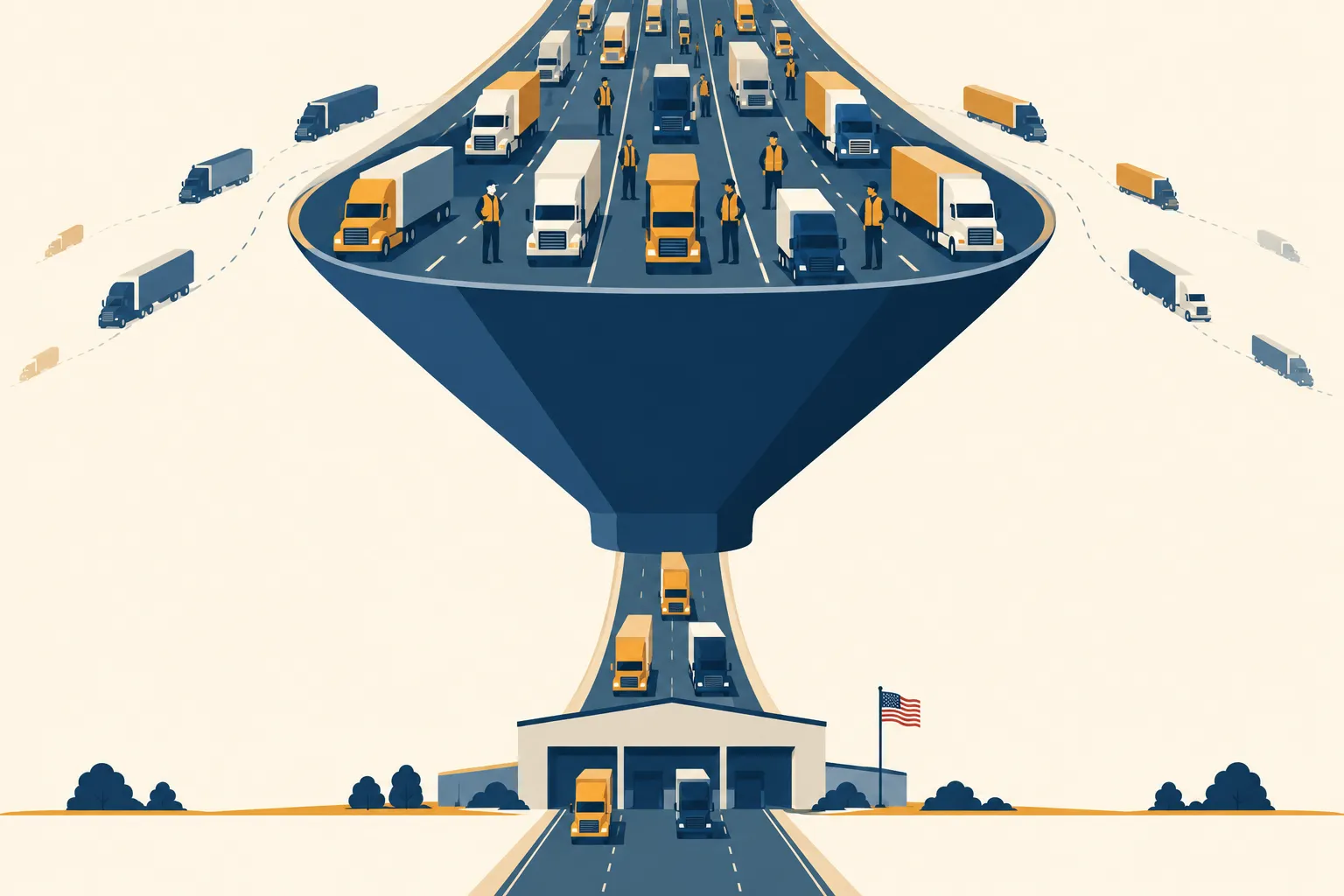
Where do driver applicants actually go?
Ask a room of carriers where their applicants went and you get the same shrug. The driver applied, somebody meant to call back, and then the trail goes quiet. The path from application to first load has more exits than most carriers realize: application, screening, paperwork, offer, orientation. A driver can leave at every one of them.
Tenstreet, a driver recruiting platform used by thousands of carriers, publishes anonymized data from its own system, covering over 1.5 million drivers through Q1 2025. Two of their findings frame this whole guide. Their platform's average hiring cycle runs 10 to 15 days, and cycles that stretch beyond that show hiring rates as much as 50% lower. And applications across the platform are drifting toward larger fleets and private fleets, which means the small carrier's share of each applicant pool is under pressure before the process even starts.
None of this means your ads stopped working. It means the application is the start of the hiring job, not the end of it.
How fast do you have to call a driver back?
Faster than feels reasonable. In that same Tenstreet dataset, carriers who respond to an application within five minutes show a 6.2% hiring rate, against a 3.7% platform average. That is about 68% higher. It is an observed pattern in one platform's data, not proof that speed alone causes hires: carriers who answer in five minutes probably run a tighter process in general. But the direction is hard to argue with, and speed is the one variable that costs nothing to improve.
Think about what the driver is doing in those five minutes. He did not apply to one job. He applied to five, sometimes in one sitting, between loads. The first real conversation usually gets his attention, and everyone after that gets his voicemail. When your intake is a form that lands in an email inbox somebody checks after lunch, your five minutes were gone before you knew the clock was running.
The same logic applies to the whole cycle. Every extra day between application and orientation is another day the driver is still answering other carriers' calls. Tenstreet's 10 to 15 day average is not a deadline; it is the point past which their data shows hiring rates falling off. Their data does not say whose fault the delay was, the carrier's or the driver's. Both show up the same way in the numbers.
Why do drivers ghost carriers?
Ghosting gets talked about like a character flaw in the modern driver. The more useful way to look at it: ghosting is the driver answering a question your process left open. The question is "am I still being considered?" and silence answers it for you.
In a 2025 survey of carriers by Conversion Interactive Agency and the Professional Driver Agency, over half of carriers reported a rise in applicants who apply and then never follow through. The reasons recruiters describe are boring, which is good news, because boring problems are fixable:
- The driver had three other conversations running and one of them moved faster.
- Days of silence during screening read as a quiet no, so he took the next offer.
- The application asked for the same information two or three times, on forms built for a desktop he does not have.
- After the verbal yes, nothing happened. No schedule, no checklist, no sign of life before orientation.
Notice what is missing from that list: pay. Pay decides which offer a driver picks when he has two live ones. It does not explain why he stops answering the carrier who went dark.

What paperwork does every driver file need?
Federal rules require a documented qualification file for every driver you put in a truck. In plain words, that file grows out of a short list of items:
- The DOT application itself: a signed form covering addresses, employment history, accidents and violations (49 CFR 391.21).
- Investigations into the driver's record: driving records and previous-employer checks, each with its own timing rules (49 CFR 391.23).
- The qualification file that keeps it all: road test, medical certificate and the rest of the paperwork that has to exist and stay current (49 CFR 391.51).
Each of these comes with its own rules and deadlines, and the details matter, so read the actual regulations or ask your safety person rather than a blog post, ours included. The links are in the sources at the bottom. The point for this guide is simpler: hiring a driver is not one decision, it is a dozen tracked steps. Every step is a place where the process stalls, the driver wanders off, or a document quietly goes missing until an auditor asks for it.
What happens when hiring lives in texts and a spreadsheet?
Here is what intake looks like at a lot of small carriers. One driver applies on a job board. Another texts the number from your Facebook ad. A third calls while you are fueling, and you write his name on the back of a receipt. All three end up in different places, in different formats, with different things missing.
Then the follow-ups live in somebody's memory, and memory quits at 6 pm. When the one person who knows the pipeline takes a day off, every open candidate freezes in place. Nobody ignores the driver on purpose. The system just has no single place where a driver exists, so keeping track of one means remembering one.

What does one lost applicant actually cost?
Start with what you already spent. The ad budget that produced the application is gone whether the driver shows up or not. Add the recruiter hours: the same driver gets copy-pasted between the job board, the spreadsheet, the text thread and the email chain, and every copy costs minutes that add up to days across a month of hiring. Add the seat. A truck without a driver earns nothing, and there is no honest public number for what that costs you, because it depends on your lanes and your rate. And add the audit exposure when a missing document surfaces at the worst possible time instead of during a calm Tuesday.
A clearer website. A better handoff.
Websites and driver application systems for trucking companies. Tell us what needs to work better in your current setup.
Driver application and follow-up systems ↗
Talk about your project ↗Which hiring problems can you fix without raising pay?
Not all of them, and any guide that tells you otherwise is selling something. Pay and home time are the top reasons drivers leave fleets. The freight market decides what you can afford. Insurance minimums screen out newer drivers no matter how good your process is. And no software creates applicants out of thin air.
What a process can fix is everything that happens after a driver raises his hand:
- Speed: the application lands somewhere that tells you immediately, so first response is measured in minutes, not lunch breaks.
- One record: the application, the documents, the hiring stage and what is still missing, in one place per driver.
- Follow-up discipline: reminders replace memory, so nobody silently goes cold.
- Visibility: you can see what still needs checking against your own requirements, instead of holding it in your head.
Here is the honest pitch. You already paid for the applicant. A tighter process means more of the applicants you already get reach orientation, without more ad spend. That is a plausible outcome, not a guaranteed one, and nobody can promise you a hiring rate. But it is the one part of driver recruiting that is completely under your control.
What does a working hiring setup look like?
It has two halves: a front door, and what happens behind it.
The front door is a hiring page built for your company. Your jobs, your pay and home time, your requirements, your name on it. A driver who clicks your ad at 11 pm on his phone gets the real picture and a form that takes two minutes: name, phone, email, CDL class, experience. No account, no app download, no forty-field application that assumes a desk.
Behind the door, every application lands on one record, and you hear about it the minute it arrives. That alert is what turns a five-minute first response from a good intention into a normal Tuesday. The driver, meanwhile, instantly gets a real answer: we received your application, here is what happens next. From his side of the fence, your company just became the one that has its act together.
From there, each applicant moves through a pipeline you can see: Applied, Reviewing, Checks pending, Offer, Orientation. Moving a driver to a new stage can send him the update that goes with it, written once by you, sent every time. Ask for a missing document and the request goes out with exactly that item named. And when somebody sits untouched for three days, you get a flag, instead of finding out two weeks later that he signed with the carrier down the road.
The paperwork gets the same treatment: a checklist per driver showing what is received, what is requested and what is still missing. And the review is yours. Rules you set, like CDL class or years of experience, flag who meets your criteria so you look at them first. Borderline always lands with you, never with an automatic rejection. Every qualification call stays with a human who knows the operation, which is you.
Add it up and the working setup is not complicated. First response in minutes. Nobody waiting in the dark. Every open candidate, his documents and his next step in one place. That is what keeps the applicants you already paid for on the road to orientation.

How do you set this up without a recruiting department?
Full disclosure: building exactly this for carriers is what we do at dytch, so yes, we have strong opinions here. We build the hiring page for your company, and we set up the applicant tracker behind it, fitted to your jobs and your requirements. It is a service, not another software subscription you have to configure yourself between dispatches.
Here is the honest limit, because you have heard every pitch by now. This will not create applicants out of thin air, it will not fix a pay package the market has already rejected, and it will not beat the freight recession. What it does is close the leak in the one part of recruiting that is completely under your control: what happens after a driver raises his hand.
If you want to see your own front door before deciding anything, email us and we will build you a free mockup of your hiring page. It is yours to keep whether or not we ever work together: dytchagency@gmail.com.
Questions carriers actually ask
Do I need an applicant tracking setup if I only hire a few drivers a year?
Small volume means each applicant is a larger share of the drivers available to you. Losing one of three applicants this quarter shrinks your pool more than losing one of thirty. And the paperwork side does not scale down: every driver you hire still means a qualification file to build and keep current.
Will a hiring page get me more applications?
It can help more of the people who already see your job complete an application. It does not guarantee traffic or applicants by itself. What it does is give the interest you already generate somewhere real to land: a driver who clicks your Facebook ad at 11 pm gets the job details and a working apply form instead of a phone number he will not call. Applications still come from your ads, groups and word of mouth. A page stops wasting them.
Is this compliance software?
No. A hiring setup tracks your process: who applied, what documents you have, what is missing, who needs a call. You still make every qualification decision, and the federal requirements are still yours to meet. Think of it as the difference between a logbook and the driving.
What about drivers who will not fill out a long form?
Then do not make them fill out a long one. A good intake starts with name, phone number, email, CDL class and experience, the handful of things you need to call back fast. The full DOT application and the documents come later, in conversation, when the driver is actually engaged. The form's job is to start the conversation, not replace it.
About this guide
This guide is by dytch, which builds websites and driver application systems for trucking companies. Questions, corrections, or a story about the one that got away: dytchagency@gmail.com.
Sources
Tenstreet, June 2025. Anonymized platform data from thousands of carriers and over 1.5 million drivers through Q1 2025: the five-minute response finding, the 10 to 15 day average cycle and the drift toward larger and private fleets. Their release calls 6.2% against 3.7% "nearly double"; the figures are about 68% higher, and the data shows association, not cause.
First Advantage, 2026. Why driver candidates ghost, citing the 2025 Conversion Interactive Agency and Professional Driver Agency carrier survey.
Global Fleet, July 2025. A recruiter's view of the bottlenecks between application and onboarding.
CDLCatch, May 2026. A vendor's take on spreadsheet hiring: scattered intake, double entry, the one-person pipeline. They sell the fix, so read it as directional.
49 CFR 391.21, 391.23 and 391.51. The federal text on the application, the investigations and the qualification file.
Overdrive reader poll, 2019. About two-thirds of small-fleet owners called recruiting and retention their number one expansion challenge. A self-selected reader poll, so treat it as a mood, not a measurement.
Drafted November 10, 2026 from the sources listed above. Advice, not legal counsel.
A clearer website. A better handoff.
Websites and driver application systems for trucking companies. Tell us what needs to work better in your current setup.
Driver application and follow-up systems ↗
Talk about your project ↗